
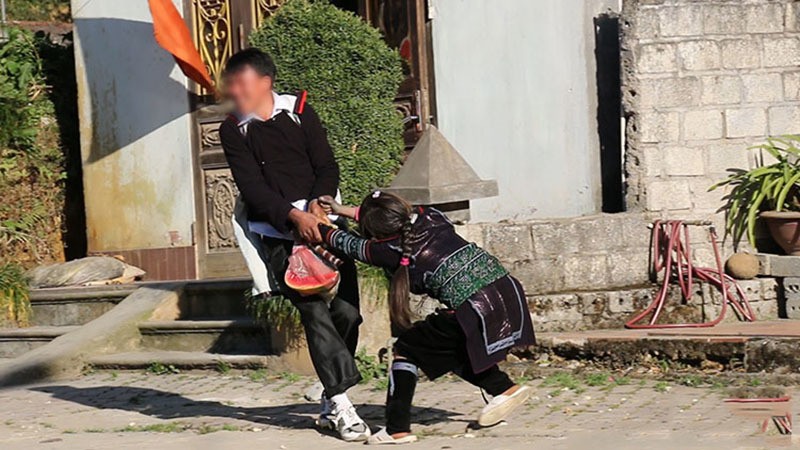
Until around the 1940’s, marriage by abduction, or “qiangqin” was very common in areas throughout China as a way to avoid paying a “price” for a bride (similar to other cultures that we have discussed). However, qiangqin was also a way for the abductor and the bride’s parents to force the bride into marriage (this was more frequent in very rural areas). Because both the “groom” and the bride’s parents were involved, this practice became very common in those areas, and was not an act that needed to be hidden or done in private.
One of the things that makes bride kidnapping in China so different than that of other cultures is the variety of forms that this practice can take. In one of the typical forms of qiangqin, the abductor would arrive at the bride’s home in a group of around 20 men, each playing a role in the abduction. The group would typically be responsible for “undressing” the woman, and then the groom would “consummate” the marriage at his home.
Another tradition that has risen from this practice was the “Bride’s Lament”. In this tradition, a new bride would sing a public song for around 2 to 3 days, expressing her worries and concerns to her family and the community.
Within recent years, bride kidnapping has risen in China again. There have been many arguments made as to why this practice is become popular again, the main one being men are selling the kidnapped women to men in poor areas in China, saying that buying a kidnapped bride is nearly one-tenth cheaper than paying for a traditional wedding. Other reasons have been tied to the gender imbalance in China, making it harder for a man to find a bride (https://www.vice.com/en_asia/article/nem7az/chinas-gender-imbalance-is-fueling-a-market-for-kidnapped-indonesian-brides).
Anne E. McLaren, “Marriage by Abduction in Twentieth Century China”, Modern Asian Studies, vol. 4, pp. 953–984.
 Bride Kidnapping Across Different Societies