
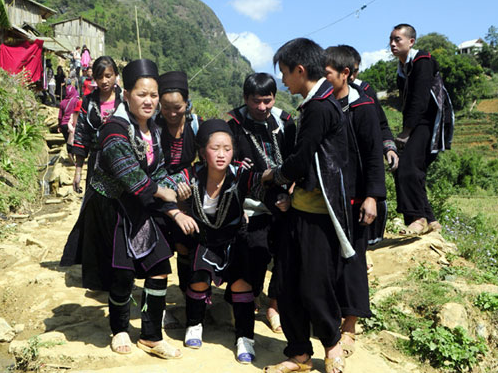
Along with most cultures, bride kidnapping in the Hmong culture (Zig Poj Niam) is often practice by a male who is from a lower social class and more than likely is not wealthy. Another common quality of bride kidnapping that the Hmong culture shares with other cultures is that the act is often done with a group of men rather than done alone. However, after researching more about “Zig Poj Niam”, it seems very similar to a violent game of “cat and mouse”. In this culture, the abductor (after kidnapping his soon-to-be bride) sends a message to the bride’s family, informing them of his intent to marry their daughter who he had just taken. If the family chooses to search and find their daughter, there is a chance that they can free her from the obligation to marry her abductor. This is usually associated with paying a fee, similar to a ransom. If they fail to find the woman, she is forced to marry her abductor.
Rather than avoiding the bride cost through kidnapping, the abductor still pays a bride price for the woman, and the price is typically increased due to having to kidnap the woman in order to marry. This is the reason that bride kidnapping in the Hmong culture is typically preformed by lower class men, often with a criminal history or poverty.
Nilda Rimonte, “A Question of Culture: Cultural Approval of Violence against Women in the Pacific-Asian Community and the Cultural Defense”, Stanford Law Review, Vol. 43, No. 6 (July 1991), pp. 1311–1326 [hereinafter Rimonte, A Question of Culture].
Teng Moua, The Hmong Culture: Kinship, Marriage & Family Systems (2003)
 Bride Kidnapping Across Different Societies